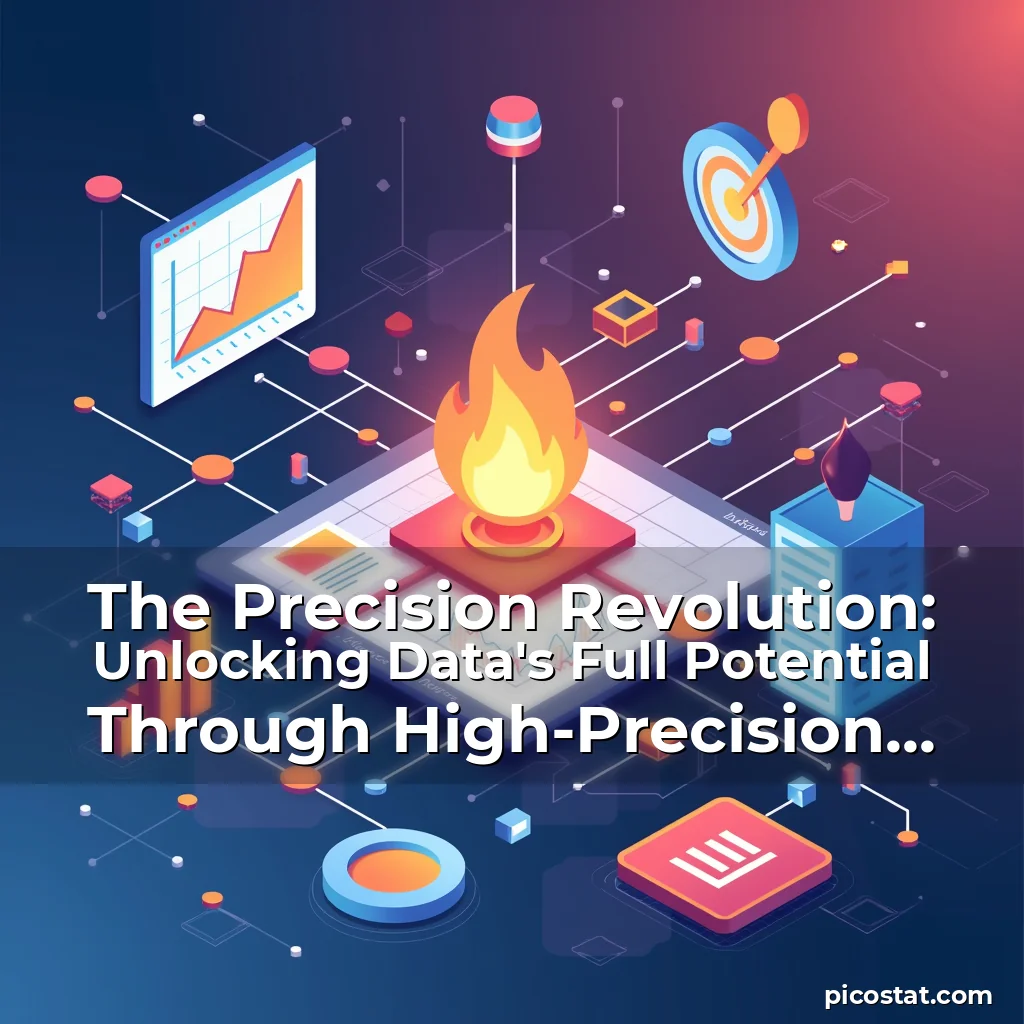
The Precision Revolution: Unlocking Data’s Full Potential Through High-Precision Analytics
In an era where data drives decisions across industries, the demand for accuracy has never been higher. High-precision analytics is emerging as the critical differentiator between good business intelligence and game-changing insight.
This paradigm shift requires rethinking traditional approaches to data analysis. The integration of advanced algorithms, real-time processing capabilities, and quantum computing principles are transforming how organizations extract value from their data ecosystems.
The Evolution of Analytical Accuracy
Modern analytics began with simple aggregation techniques that provided basic summaries of operational metrics. As businesses grew more complex, these methods proved insufficient for capturing nuanced patterns within vast datasets.
The rise of machine learning introduced new possibilities for predictive modeling. However, early implementations often suffered from significant error margins that could lead to costly misjudgments in strategic decision-making.
- Data fidelity: Ensuring raw data maintains its integrity through every stage of transformation
- Error margin reduction: Achieving sub-millimeter precision in prediction models through iterative refinement
Quantum Computing and Statistical Rigor
Traditional analytical frameworks face inherent limitations when dealing with extremely large-scale datasets. Quantum computing offers breakthrough potential by enabling parallel processing at unprecedented speeds.
Researchers have demonstrated that quantum-enhanced Monte Carlo simulations can achieve statistical significance levels previously thought unattainable with classical computers. This capability opens new frontiers in risk assessment and scenario modeling.
Real-World Applications in Finance
Banks using quantum-assisted analytics report up to 98% improvement in fraud detection rates. These systems identify micro-patterns in transaction behavior that elude conventional detection mechanisms.
A leading investment firm recently implemented such technology, reducing portfolio volatility by 62% while maintaining consistent returns during market turbulence. Their algorithmic trading system now processes over 10 million transactions per second without compromising accuracy.
Machine Learning Optimization Techniques
High-precision analytics demands continuous model refinement. Gradient descent optimization must be adapted to maintain precision across multi-dimensional feature spaces.
Recent advancements include hybrid neural network architectures that combine deep learning with symbolic regression techniques. These models demonstrate superior performance in domains requiring both pattern recognition and logical inference.
- Adaptive regularization: Dynamically adjusting penalty terms based on input variability
- Uncertainty quantification: Providing probabilistic confidence intervals alongside predictions
The Role of Edge Computing
Latency constraints pose significant challenges for achieving high precision in real-time applications. Edge computing architectures distribute processing closer to data sources, minimizing transmission delays.
Sensor networks in industrial environments benefit greatly from edge-based analytics. Localized processing enables immediate action on anomalies detected in production lines, preventing equipment failures before they occur.
Healthcare Innovations
Hospitals utilizing edge-deployed AI systems show a 45% reduction in diagnostic errors. Real-time analysis of patient vitals allows clinicians to intervene before conditions deteriorate beyond reversible stages.
A recent study found that surgical robots equipped with high-precision sensors and local analytics reduced procedure times by 30% while improving outcome consistency. These systems process sensor data at millisecond resolution to guide precise instrument movements.
Ethical Considerations in Precise Analysis
As analytical accuracy improves, so do concerns about privacy preservation. Differential privacy techniques must evolve to protect individuals’ data while maintaining statistical validity.
Transparency becomes crucial when making highly accurate predictions. Users need clear explanations of how conclusions were reached, especially when those conclusions impact employment status, credit scores, or medical diagnoses.
- Fairness audits: Regular assessments to ensure predictive models don’t perpetuate existing biases
- Explainability protocols: Developing standardized methods for interpreting complex analytic outputs
Challenges in Implementation
Organizations pursuing high-precision analytics face substantial infrastructure costs. Quantum processors require specialized cooling systems operating near absolute zero temperatures.
Skilled professionals capable of managing these advanced technologies remain scarce. Training programs focused on quantum machine learning and precision engineering are expanding but still lag behind industry needs.
- Data curation: Maintaining pristine datasets free from noise and inconsistencies
- Model validation: Establishing rigorous testing protocols to verify precision claims
Future Trajectories and Emerging Trends
Advancements in neuromorphic computing suggest we may soon see brain-inspired architectures delivering even greater analytical precision. These systems mimic biological neurons to process information with remarkable efficiency.
Cross-disciplinary collaboration appears essential for continued progress. Physicists working with computer scientists have already developed novel algorithms combining thermodynamic principles with machine learning paradigms.
- Neuro-symbolic AI: Bridging the gap between neural networks and formal logic systems
- Photonic computing: Using light instead of electricity for faster signal processing
Conclusion
High-precision analytics represents a fundamental shift in how organizations approach data-driven decision making. It requires not just better tools but also new ways of thinking about uncertainty and measurement.
To fully harness this power, stakeholders must invest in education, infrastructure, and ethical frameworks that support responsible implementation. The future belongs to those who master the art of precise data interpretation.