The Correlation Check Kit
Tell a real relationship from noise before you act on it: the spread, the p-value, the range, the one loud point, the share explained, the pairs to collect and the rivals to rule out
PicoStat's Correlation calculator gives r, r squared and a label: Weak, Moderate or Strong. The label reads the size of r and never looks at how many pairs you have. Its own default example, five pairs with r = 0.7746, is labelled Strong; the textbook test on those five pairs gives a p-value of 0.124, and the 95% range for the true correlation runs from -0.34 to 0.98. Strong, and not yet evidence of anything. The Correlation Check Kit adds what the label leaves out, in seven steps built on the site's own Correlation, Standard Deviation, Z-Score and Sample Size calculators. Check that the pairs belong together and both lists vary (r is the same on the n and the n - 1 divisor, and a flat list has no r). Put n next to r as a p-value. Quote the Fisher 95% range. Refit without the loudest point: in a made-up set of ten pairs, one point turns r = 0.11 into r = 0.88, and its z-scores never reach 3 because ten values cannot (the most any one can reach is 2.846). Read r squared as a share: r = 0.05 on 2,000 pairs is significant and explains 0.25%. Decide the pairs before you look (85 to detect a true r of 0.3 with 80% power). And name the rival (chance, a third factor, the reverse direction, the way the data were picked) before you write "because": ten columns in a correlation matrix is 45 tests and a 90% chance of at least one false alarm. Every figure is computed from textbook formulas and every data set is an example, never presented as real. Correlation is not causation and significance is not importance, and the kit says where each matters. It is for checking your own analysis and learning, not for answering graded work. Included: 24 printable pages with a correlation check worksheet, a refit log, a rivals sheet, a study plan, reference tables of critical r and 95% ranges, a quickstart, and a personalised sheet worked from the figures you enter in the correlation, standard deviation, z-score and sample size calculators.
Look inside
Two full pages from the kit, exactly as printed. Click either to read it at full size before you decide.
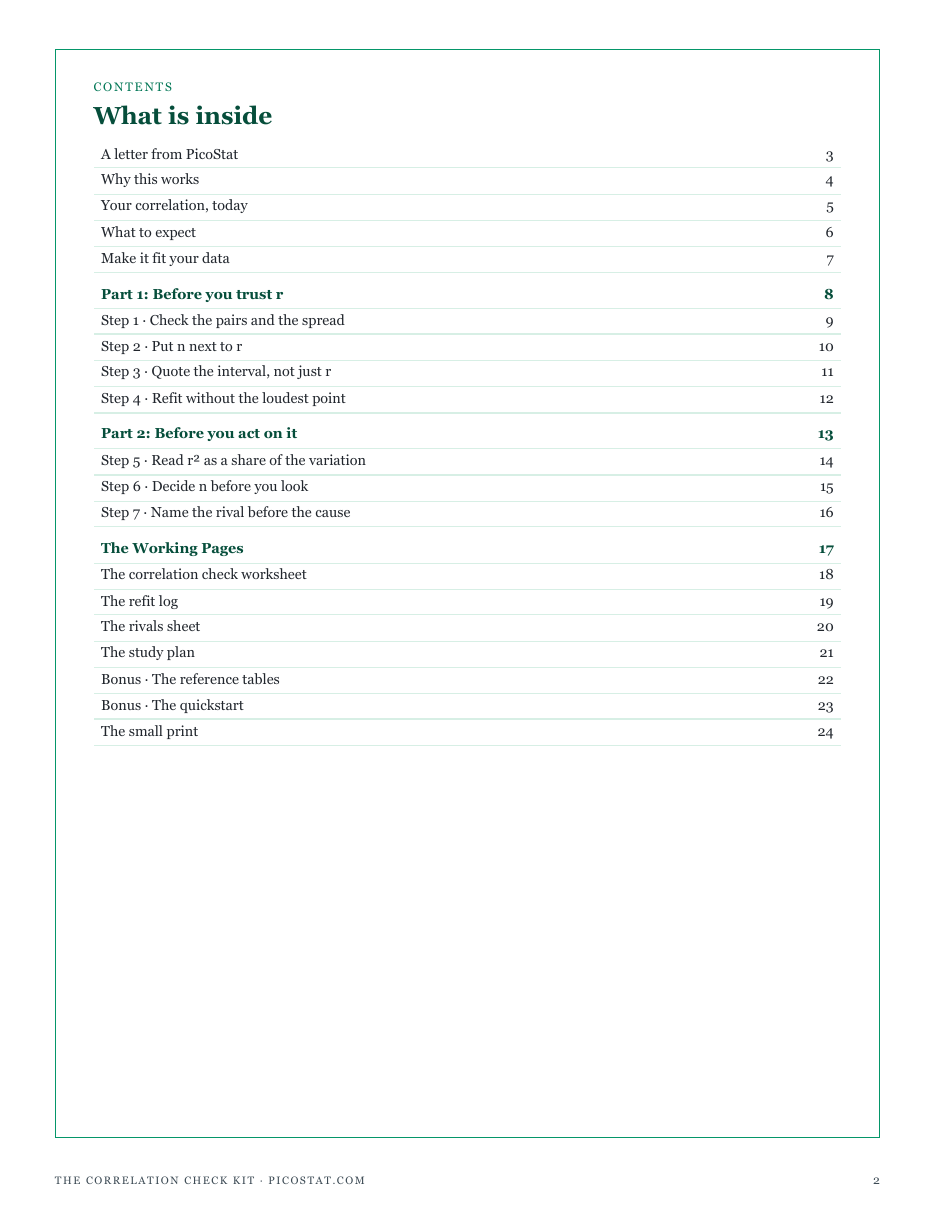
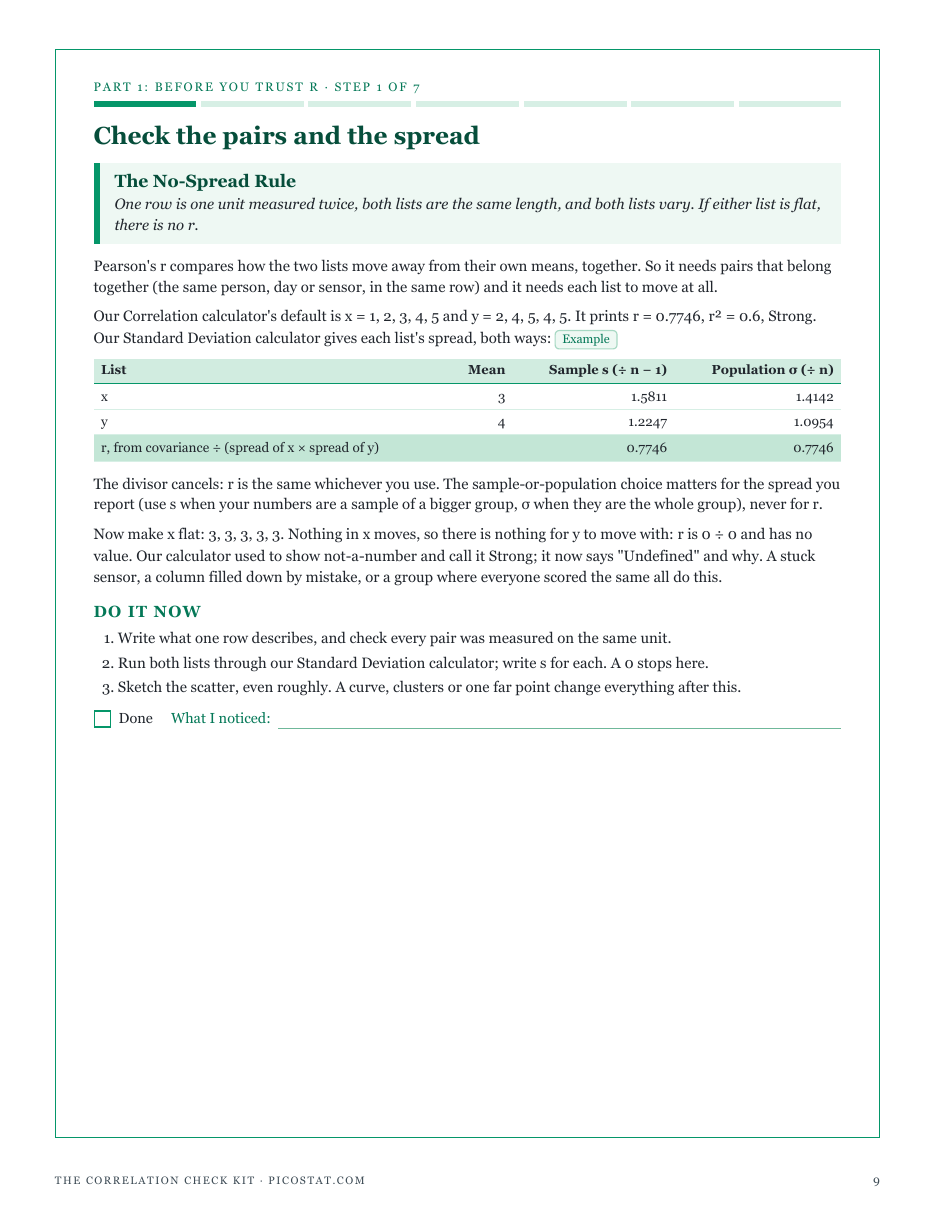
What is in it
- The No-Spread Rule: pairs that belong together, both lists that vary, and why r is the same on either divisor
- The Size-Is-Not-Evidence Rule: the t test of r, the p-value worked by hand, and the r each n needs
- The Interval Rule: the Fisher 95% range for r, worked, and how it narrows with n
- The One-Point Rule: the refit without the loudest pair, and why a small sample can never reach |z| = 3
- The Importance Rule: r squared as a share of the variation, and why a huge n makes a tiny r significant
- The n-First Rule: the pairs to collect for 80% and 90% power, decided before you look
- The Rival Rule: chance and many tests at once, a third factor, the reverse direction and the picking
- Four working pages: a correlation check worksheet, a refit log, a rivals sheet and a study plan
- Reference tables: critical r at 0.05 and 0.01 and 95% ranges for r = 0.3, 0.5 and 0.7, from 4 to 1,000 pairs
- A personalised sheet worked from the figures you enter in the correlation, standard deviation, z-score and sample size calculators
- ✓ 24 printable pages
- ✓ 10 sections, worksheets and templates
- ✓ A second PDF worked out from the numbers you enter
- ✓ No account needed, just an email address
- ✓ Instant download; link valid 7 days
Price includes any taxes. Sold by GrabURL, who handle checkout and support. The charge appears on your statement as GrabURL.
The kit picks up where the free Correlation Calculator leaves off. The calculator gives r, r² and a size label; the kit puts n next to r as a p-value and a 95% range, refits without the loudest point, reads r² as a share of the variation, sizes the next study, and lists the rivals to rule out before you write “because”. It works with the Standard Deviation Calculator and the Z-Score Calculator. Every data set in it is an example, and it is for checking your own analysis and learning: it is not a way to answer graded work.